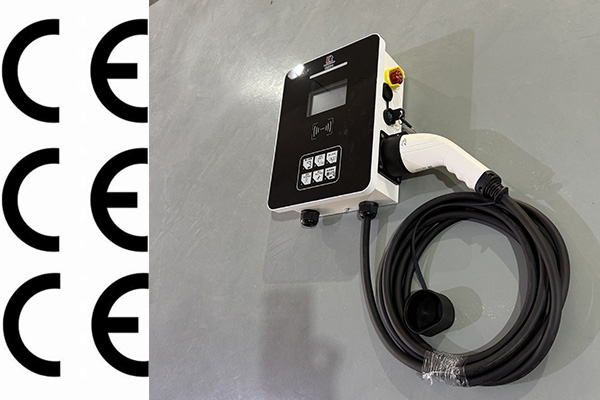

Choosing the right DC charger power is easy—you just need to know three things: the voltage of the country’s power grid, local rules, and how the charger will be used. DC chargers are fast chargers, perfect for commercial use (like malls, gas stations) and fleet depots (like logistics or taxi companies). This guide is simple, no technical jargon—you can read it quickly and use it directly when talking to customers.
The main reason DC charger power differs by country is the power grid voltage. Higher voltage means the grid can support more powerful chargers. Some countries have strong grids that handle high power; others have weaker grids that need lower-power chargers to avoid problems. Most importantly, power directly determines charging speed—the higher the power, the faster the charging. This is what customers care most about: how quickly they can get their cars back on the road. Let’s break down each region simply, plus add charging time for each power level.
First: The Basics (What You Need to Know)
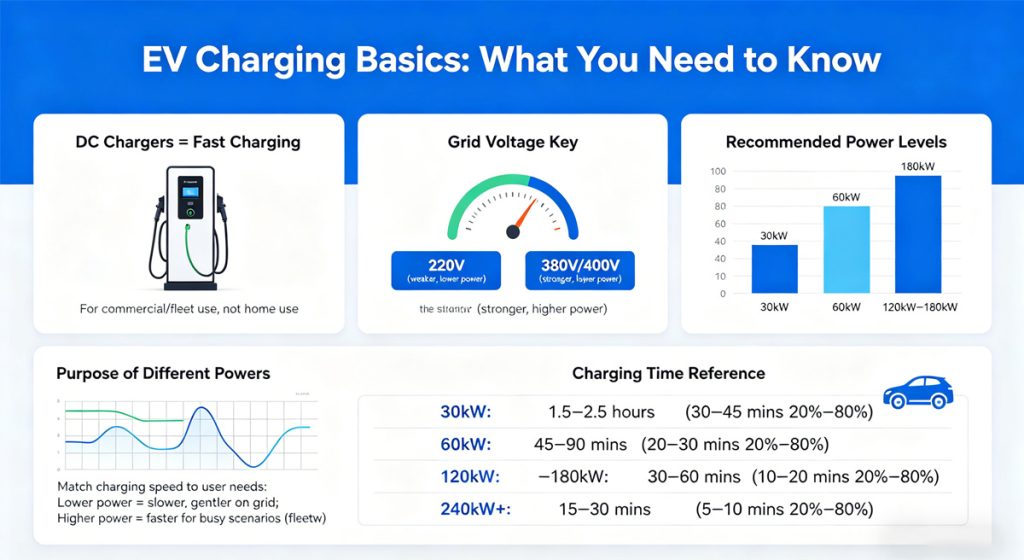
- DC chargers = fast charging (for commercial/fleet use, not home use).
- Grid voltage key: 220V (weaker, lower power) / 380V/400V (stronger, higher power).
- We recommend 3 power levels most of the time: 30kW, 60kW, 120kW–180kW. No need for more complicated options.
- Charging time reference (for most electric cars with 50-70kWh batteries, the most common size)
- 30kW: Takes about 1.5–2.5 hours to fully charge (or 30–45 minutes to charge from 20% to 80%, the most common charging range).
- 60kW: Takes about 45–90 minutes to fully charge (or 20–30 minutes to charge from 20% to 80).
- 120kW–180kW: Takes about 30–60 minutes to fully charge (or 10–20 minutes to charge from 20% to 80).
- 240kW+: Takes about 15–30 minutes to fully charge (or 5–10 minutes to charge from 20% to 80, for long-distance travel).
- What’s the purpose of different powers? Simple: match charging speed to user needs. Lower power = slower charging but gentler on the grid; higher power = faster charging for busy scenarios (like fleets or highways).
DC Charger Power Recommendations by Country/Region
We’ll keep this simple: region → grid voltage → recommended power (and why) → charging time.
1. Asia (China, Southeast Asia, Central Asia)
China & Southeast Asia (Thailand, Malaysia, Vietnam)
- Grid: 220V (home) / 380V (commercial/industrial, easy to get).
- Recommended Power:
- Malls, hotels, gas stations: 30kW–60kW. Fast enough, works with most grids, perfect for customers who need a quick charge.
- Charging time: 30kW (1.5–2.5 hours full charge / 30–45 minutes 20%-80%), 60kW (45–90 minutes full charge / 20–30 minutes 20%-80%)
- Logistics/fleet depots: 120kW–180kW. Fleet cars need fast charging to keep working—this power gets them back on the road quickly.
- Charging time: 30–60 minutes full charge / 10–20 minutes 20%-80% .
Central Asia & Russia (Kazakhstan, Russia)
- Grid: 220V (home) / 400V (industrial, good in cities).
- Recommended Power:
- Cities (malls, parking lots): 60kW. Most popular—fast and stable.
- Charging time: 45–90 minutes full charge / 20–30 minutes 20%-80%.
- Fleet/industrial areas: 120kW–180kW. Strong grids support high power, good for busy fleets. Charging time: 30–60 minutes full charge / 10–20 minutes 20%-80%
- Remote areas: 30kW. Weaker grids, so lower power is more stable. Charging time: 1.5–2.5 hours full charge / 30–45 minutes 20%-80%.
2. Europe (EU, UK, Eastern Europe)
- Grid: 230V (home) / 400V (commercial, all over).
- Key rule: Europe limits grid load—no super high-power chargers in most areas.
- Recommended Power:
- Malls, urban parking: 60kW–120kW. Perfect balance—fast enough, compliant with local rules. Charging time: 60kW (45–90 minutes full charge / 20–30 minutes 20%-80%), 120kW (30–60 minutes full charge / 10–20 minutes 20%-80%).
- Highways: 120kW–180kW. Busy areas need faster charging, and highways have stronger grids. Charging time: 30–60 minutes full charge / 10–20 minutes 20%-80%.
- Residential areas (public charging): 30kW. Strict load limits, so lower power is better. Charging time: 1.5–2.5 hours full charge / 30–45 minutes 20%-80% .
3. Latin America (Brazil, Mexico, Colombia)
Brazil
- Grid: 127V/220V (home) / 380V (cities only, not widespread). Grid is weak—easy to overload.
- Recommended Power:
- Cities (malls, gas stations): 30kW–60kW. Most stable—higher power (120kW+) may break the grid. Charging time: 30kW (1.5–2.5 hours full charge / 30–45 minutes 20%-80%), 60kW (45–90 minutes full charge / 20–30 minutes 20%-80%) .
- Fleet depots (big cities): 60kW–120kW (only if the area has 380V grid). Charging time: 60kW (45–90 minutes full charge / 20–30 minutes 20%-80%), 120kW (30–60 minutes full charge / 10–20 minutes 20%-80%).
Mexico, Colombia
- Grid: 400V (commercial, easy to get), better stability than Brazil.
- Recommended Power:
- Malls, cities: 60kW–120kW. Fast and works with local grids. Charging time: 60kW (45–90 minutes full charge / 20–30 minutes 20%-80%), 120kW (30–60 minutes full charge / 10–20 minutes 20%-80%).
- Fleet depots: 120kW. Strong grids support high power for busy fleets. Charging time: 30–60 minutes full charge / 10–20 minutes 20%-80%.
4. Middle East & Africa (UAE, Saudi Arabia, South Africa)
- Grid: 400V–415V (commercial/industrial, very strong). No strict load limits—customers want fast charging.
- Recommended Power:
- Malls, gas stations: 120kW–180kW. Most popular—fast charging attracts customers. Charging time: 30–60 minutes full charge / 10–20 minutes 20%-80% .
- Fleet/bus depots: 180kW–240kW. Fleet cars need quick charging to keep working. Charging time: 15–45 minutes full charge / 5–15 minutes 20%-80%.
- Highways: 240kW+. Ultra-fast for long-distance travel, works with strong grids. Charging time: 15–30 minutes full charge / 5–10 minutes 20%-80%.
3 Questions to Ask Customers (Never Recommend Wrong)
Just ask these 3 simple questions, and you’ll pick the right power every time:
- What’s the local voltage? (220V/380V/400V?)
- Is the charger for a mall/gas station (commercial) or a fleet depot?
- Does the area have a strong grid (can it handle high power) or a weak one?
Final Simple Tip
Don’t choose the highest power—choose the power that fits the local grid and how the charger will be used. Remember: power = charging speed—higher power is for busy scenarios where time matters (like fleets), lower power is for stable, low-demand areas. 30kW, 60kW, 120kW–180kW cover 90% of needs. This way, you’ll avoid problems and make customers happy.
Note: Charging time is an estimate—actual time may vary slightly based on the car’s battery size, battery temperature, and grid stability.
Need help picking power for a specific country? Contact us, and we’ll give you a direct recommendation.