
One of the most critical questions for new and seasoned EV owners alike is: “How much charging power do I actually need?” The answer is not a one-size-fits-all number—instead, it hinges on a combination of your vehicle’s capabilities, daily driving habits, charging scenarios, and even your home’s electrical infrastructure. Choosing the right kW (kilowatt) rating for your EV charger can mean the difference between convenient, overnight full charges and frustratingly slow top-ups, or between cost-effective installation and unnecessary expenses. In this guide, we’ll break down the science of EV charger power calculation, demystify key terms, and help you determine the perfect kW rating for your unique needs.
First: Understand the Basics of EV Charger Power
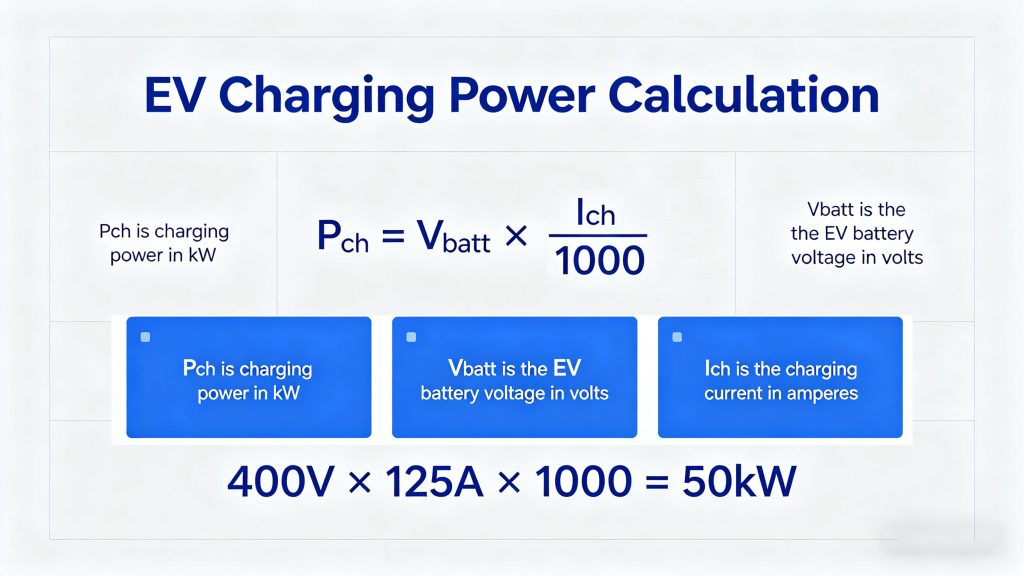
Before diving into calculations, it’s essential to distinguish between two core concepts that define charging speed: power (measured in kW) and energy (measured in kWh, or kilowatt-hours). Power is the rate at which energy is transferred to your EV’s battery—think of it as the “flow rate” of electricity. Energy, on the other hand, is the total amount of electricity stored in the battery, which directly translates to driving range. A higher kW rating means faster charging, but it doesn’t necessarily mean you need the highest possible number to meet your needs.
Key Factors That Determine Your Required kW
To calculate the right kW for your EV charger, you need to evaluate three primary factors: your vehicle’s maximum charging capacity, your daily energy consumption, and your charging scenario (home, public, or long-distance travel).
1. Your EV’s Maximum Acceptable Power
Every EV has a built-in AC-to-DC converter called an “onboard charger (OBC),” which determines the maximum power the vehicle can safely accept from an AC charger. This is the most critical limiting factor—installing a charger with a higher kW rating than your EV’s OBC can handle is a waste of money, as the vehicle will only draw the power it can process. For example:
- Compact EVs like the Nissan Ariya or Hyundai Kona Electric typically have an OBC capacity of 7.2kW, meaning they can’t utilize more than 7.2kW from an AC charger.
- Mid-size and high-performance EVs, such as the Tesla Model Y, Ford Mustang Mach-E, or Kia EV6, often have OBC capacities of 11kW, allowing them to charge faster with a compatible 11kW charger.
- Some premium models, like the Porsche Taycan or Ford F-150 Lightning, can accept up to 19kW from AC chargers, though this requires a 380V three-phase power supply.
For DC fast chargers (common in public spaces), the vehicle’s maximum DC charging capacity is separate from the OBC—these chargers bypass the onboard converter and deliver DC power directly to the battery, enabling much higher power levels (50kW to 600kW+).
2. Your Daily Energy Consumption
Your daily driving habits dictate how much energy you need to replenish each day. Start by calculating your average daily energy usage, which depends on your commute distance and driving conditions (highway vs. city, weather, and vehicle efficiency). Here’s how to do it:
- Estimate your average daily miles driven (e.g., 40 miles per day).
- Find your EV’s energy efficiency (usually listed as kWh per 100 miles; e.g., 15 kWh/100 miles).
- Calculate daily energy needs: (Daily Miles ÷ 100) × Energy Efficiency. For 40 miles and 15 kWh/100 miles, this equals 6 kWh per day.
Next, consider your available charging time (e.g., 8 hours overnight). Use the formula
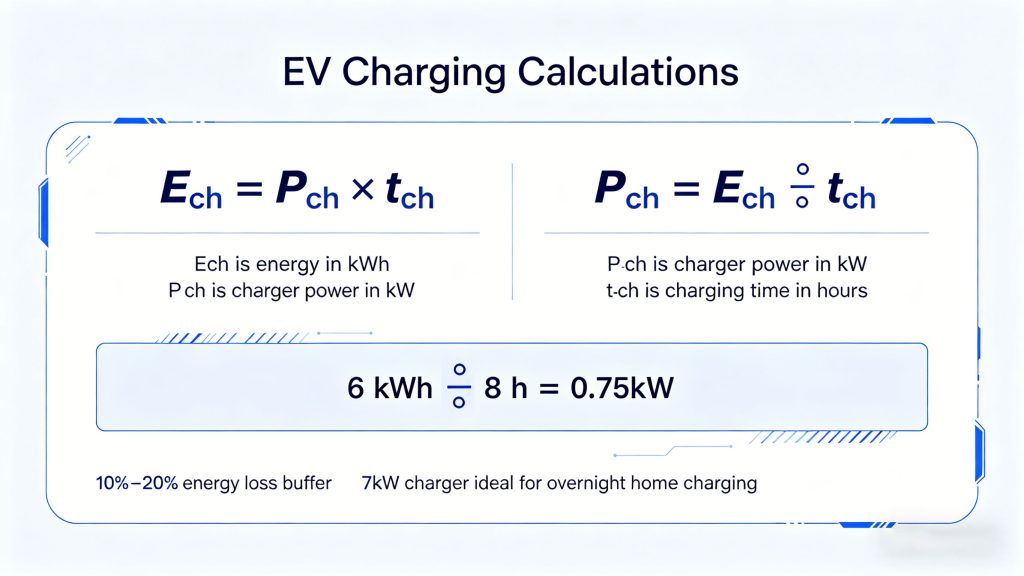
For 6 kWh needed over 8 hours, you only need 0.75kW—but this is a theoretical minimum. In reality, you’ll want a buffer for energy losses (typically 10-20%) and unexpected longer drives. For most daily commutes, a 7kW charger will easily replenish 40-50 miles of range per hour, making it more than sufficient for overnight charging.
3. Your Charging Scenario
The location where you charge most frequently—home, public spaces, or highways—will heavily influence your kW needs.
Home Charging (Most Common Scenario)
Home charging is the most convenient and cost-effective option for most EV owners, and it’s where your kW choice matters most. Home chargers are typically AC chargers, available in three main power levels:
- 3.5kW (Level 1/Entry-Level AC): Uses a standard 220V household socket (16A) and is often the portable charger included with EVs. It delivers about 25-30 miles of range per hour, making it suitable only for old residential with limited grid capacity or as a backup for emergency charging. A 60kWh battery would take 17+ hours to fully charge, which is impractical for daily use.
- 7kW (Level 2/Standard Home AC): The “golden standard” for most households, as it works with a 220V single-phase power supply (no complex grid Transformation) and is compatible with 90%+ of EVs. It delivers 40-50 miles of range per hour, meaning a 60kWh battery can be charged from 20% to 80% in 5-6 hours—perfect for overnight charging.
- 11kW-21kW (Level 2/High-Power Home AC): Requires a 380V three-phase power supply, which is not available in most residential homes (you’ll need to apply for a three-phase industrial meter). These chargers deliver 70-120 miles of range per hour, cutting charging time by 40-50% compared to 7kW models. They’re ideal for high-performance EVs or households with multiple EVs, but the higher installation cost and grid requirements make them unnecessary for most users.
Public Charging
Public charging stations are designed for quick top-ups while you’re out and about, and they come in two main types:
- Level 2 Public Chargers (7kW-11kW): Found in shopping malls, offices, and parking lots, these are similar to home Level 2 chargers. They’re ideal for 1-2 hour stops (e.g., while shopping) and can add 40-70 miles of range in that time.
- DC Fast Chargers (50kW-600kW+): Located in highway rest areas, gas stations, and dedicated charging hubs, these are for rapid charging during long trips. A 50-120kW “regular fast charger” can add 50% charge in 30 minutes for 400V voltage platform EVs, while 200-600kW “ultra-fast chargers” (compatible with 800V models like the Xpeng G9 or Porsche Taycan) can add 500km of range in 12 minutes. Note that frequent use of ultra-fast charging can accelerate battery degradation—limit it to 2-3 times per week.
Avoid Common Mistakes in kW Selection
Many EV owners fall into the trap of thinking “higher kW is better,” but this often leads to unnecessary costs and wasted potential. Here are two common mistakes to avoid:
- Overpaying for a higher kW charger than your EV can use: If your EV’s OBC only supports 7kW, a 21kW charger will not charge your vehicle faster—it will simply operate at 7kW, and you’ll have spent extra on a feature you can’t use. Always check your EV’s manual for its maximum AC and DC charging capacities before buying a charger.
- Underestimating grid capacity: A 7kW charger requires a dedicated 32A circuit, while 11kW+ chargers need three-phase power. Before installing a home charger, consult an electrician to check if your home’s electrical panel and wiring can handle the load. Upgrading your electrical system can add significant costs, so it’s better to choose a charger that matches your existing infrastructure unless you’re willing to invest in upgrades.
Final Calculation: What kW Do You Need?
Putting it all together, here’s a step-by-step process to calculate your ideal EV charger kW:
- Check your EV’s maximum AC charging capacity (OBC rating) from the owner’s manual or manufacturer’s website.
- Calculate your daily energy needs (kWh) based on your commute and vehicle efficiency.
- Determine your available charging time (e.g., 8 hours overnight).
- Use the above fomular to find your minimum required kW.
- Choose a charger kW that is ≤ your EV’s maximum AC capacity and ≥ your minimum required kW, and that is compatible with your home’s electrical grid.
Conclusion
Choosing the right EV charger kW is about balance—matching your vehicle’s capabilities, daily habits, and infrastructure to avoid overspending or underperforming. For 90% of home EV owners, a 7kW Level 2 charger is the sweet spot: it’s affordable, compatible with most EVs, works with standard residential power, and provides fast enough charging for daily use. If you drive a high-performance EV, have multiple EVs, or have access to three-phase power, an 11kW-21kW charger may be worth the investment. For public charging, use Level 2 chargers for short stops and DC fast chargers for long trips, but prioritize compatibility with your vehicle’s voltage platform.
Remember: the goal is not to have the highest kW charger, but to have one that fits your lifestyle. By following the steps in this guide, you can calculate the exact kW you need and enjoy the convenience of hassle-free EV charging for years to come.