
What charging Power is sufficient for heavy trucks? If the power is too low, charging time will be too long, affecting operational efficiency; if the power is too high, it may lead to wasted investment and increased pressure on power capacity expansion. This article explains this clearly from a practical application perspective.
I. First, understand: The power logic of charging piles for heavy trucks and passenger cars is completely different.
Ordinary passenger car batteries are only 50-100kWh, and a 120kW charging pile is sufficient for fast charging;
however, electric heavy truck batteries generally have a capacity of 300-600kWh, and newer long-haul heavy trucks can reach 700-800kWh, 6-10 times the battery capacity of passenger cars.
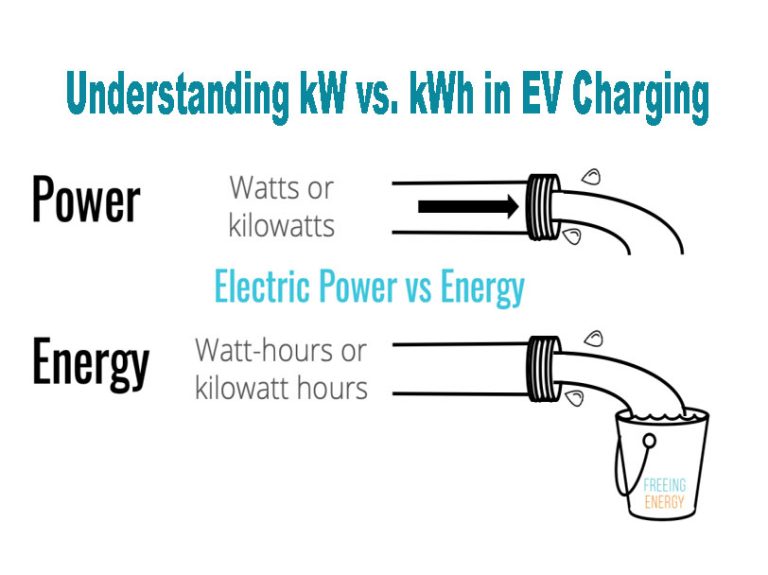
Basic charging formula: Charging time ≈ Battery capacity ÷ Charging pile power × 0.95 (charging conversion efficiency)
Taking a mainstream 400kWh heavy-duty truck battery as an example:
160kW charging pile: 20%-80% charging takes approximately 1.8 hours, a full charge takes over 2.5 hours.
400kW dual-gun DC charging pile: 20%-80% charging takes only 35-45 minutes, a full charge takes over 1 hour.
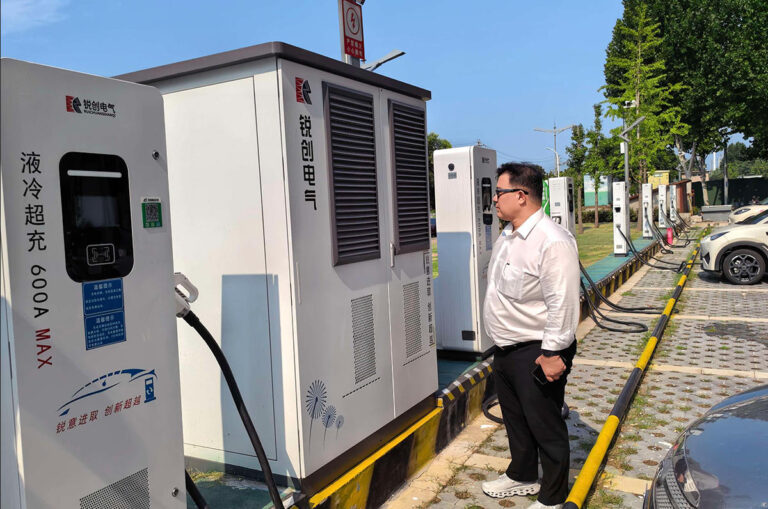
600kW liquid-cooled supercharging pile: 20%-80% charging takes only 25 minutes, approaching the refueling efficiency of gasoline vehicles.
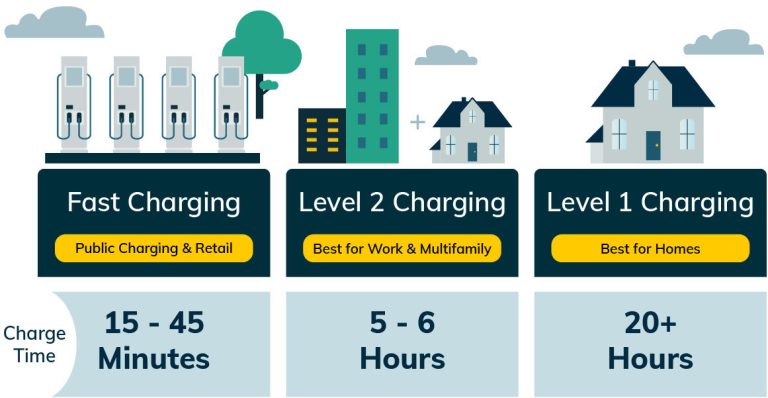
7-20kW AC slow charging: A full charge takes over 20 hours, only suitable for overnight charging during off-peak hours.
The core pain point in heavy-duty truck operation is that time equals freight revenue; drivers will not stay for more than 2 hours to charge. The core of a charging station's profitability is the number of vehicles served per charging pile per day (turnover rate); incorrect power matching directly determines whether a charging station can make money.
II. Selecting the Optimal Charging Power for Different Scenarios
The selection of charging station power for heavy-duty trucks needs to consider scenario requirements, vehicle compatibility, and cost-effectiveness. The mainstream choice is 320kW to 400kW, while megawatt-level (1MW and above) supercharging solutions can be used in extreme scenarios.
Heavy-duty Truck Charging Pile Power Selection Table by Scenario (Simplified)
| Application Scenario | Vehicle & Operation Features | Recommended Power | Core Benefits |
|---|---|---|---|
| Urban Short-haul & Logistics Park | Short daily mileage, night centralized charging, low queuing pressure | 320kW–400kW Air-cooled DC Pile | Cost-effective, easy grid access, high turnover, ideal for fleet self-use |
| Highway & Intercity Hub | Long-haul trucks, short rest charging window, high efficiency demand | 480kW–600kW Liquid-cooled Ultra-fast Pile | 25-minute fast charging, stable full-power output, no thermal derating |
| Port, Mine & Industrial Site | 24h continuous operation, high vehicle density, frequent quick top-up | 1MW–1.44MW Centralized Charging Cluster | Shared power pool, multi-truck simultaneous charging, ultra-fast energy supplement |
| Parking Lot & Night Standby | Off-peak low-cost charging, no urgent speed requirement | 7kW–20kW AC Slow Charger (Auxiliary Only) | Low cost, reduce fleet electricity expense for overnight standby charging |
III. How to Choose a Heavy-Duty Truck Charging Station
Three Common Pitfalls When Choosing Heavy-Duty Truck Charging Stations
Many clients fail to build charging stations not because of equipment issues, but because of flawed selection logic:
❌ Focusing only on single-unit power, ignoring fleet size
Result: Severe truck queuing, low station utilization
❌ Ignoring power capacity
Result: Equipment cannot be installed or forced to operate at reduced power
❌ Considering only charging speed, ignoring return on investment
Result: Excessively high upfront costs, longer payback period
? The correct logic should be:
Fleet size + Operating time + Power conditions = Optimal power solution
IV. How Can Charging Station Companies Provide Solutions for Customers?
As a professional heavy-duty truck charging pile manufacturer, we offer more than just equipment; we provide complete heavy-duty truck charging station solutions:
- Free Solution Design (Avoid Choosing the Wrong Power)
We will calculate for you based on your project requirements:
Total power in kW required
Number of charging piles needed
Is liquid-cooled supercharging required?
Is phased construction necessary?
? Helping you avoid "buying the wrong equipment = wasting hundreds of thousands or even millions"
- Overall Charging Station Planning
This includes not only equipment but also:
Multi-gun charging design (improving utilization)
Charging queue optimization solutions
Peak-valley electricity pricing optimization
Transformer capacity planning
? Goal: To make every kilowatt-hour generate revenue
- Reduce Overall Investment Costs
Through solution optimization, we can help customers:
Reduce unnecessary power configuration
Construct charging stations in phases
Improve equipment utilization
Reduce the pressure of power capacity expansion