
When you search for a DC charging solution, you may concern the question as follows:
- How fast can a DC EV charger charge an electric vehicle?
- What is a DC EV charger and how does it work?
- What is the difference between AC and DC charging?
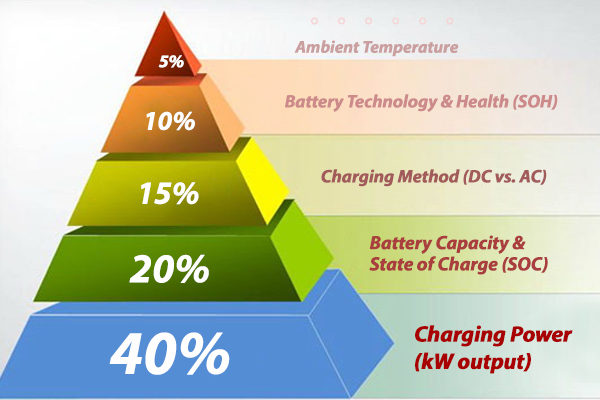
- How much charging power does an EV need?
- Is a 60kW, 120kW, or 240kW charger suitable?
- Which charging scenarios require high-power charging?
- How to choose a reliable EV charger manufacturer?
A complete understanding of these questions helps companies build more efficient and profitable EV charging networks.
1. What Is a DC EV Charger?
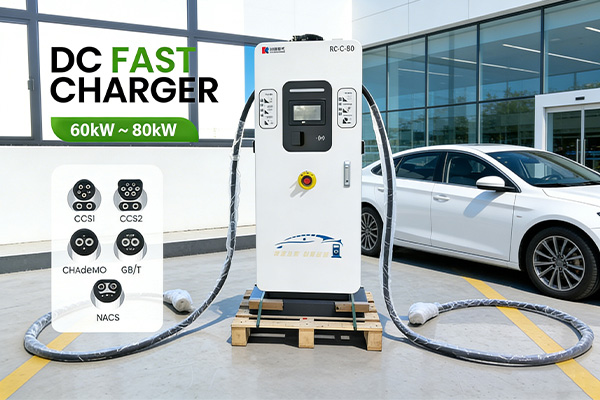
A DC EV charger, also called a DC fast charger, is an electric vehicle charging device that directly delivers DC power to the vehicle battery.
Unlike AC chargers, which require the vehicle's onboard charger to convert AC power into DC power, DC chargers perform the power conversion inside the charging station.
This allows:
- Higher charging power
- Faster charging speed
- Better efficiency for commercial applications
DC EV chargers are commonly used in:
- Public charging stations
- Highway charging networks
- EV fleet charging
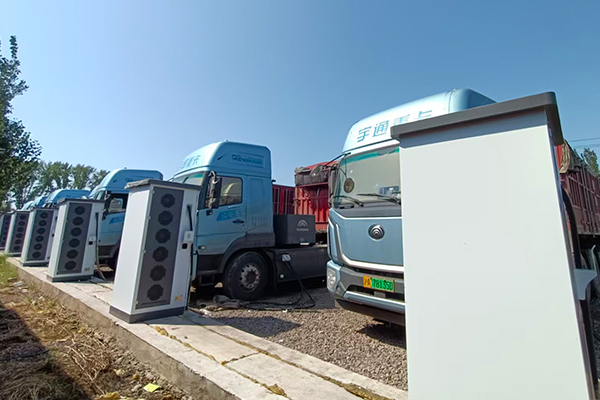
- Bus and truck charging stations
- Commercial parking areas
- Industrial facilities
For businesses operating multiple electric vehicles, DC fast charging provides a more efficient energy solution.
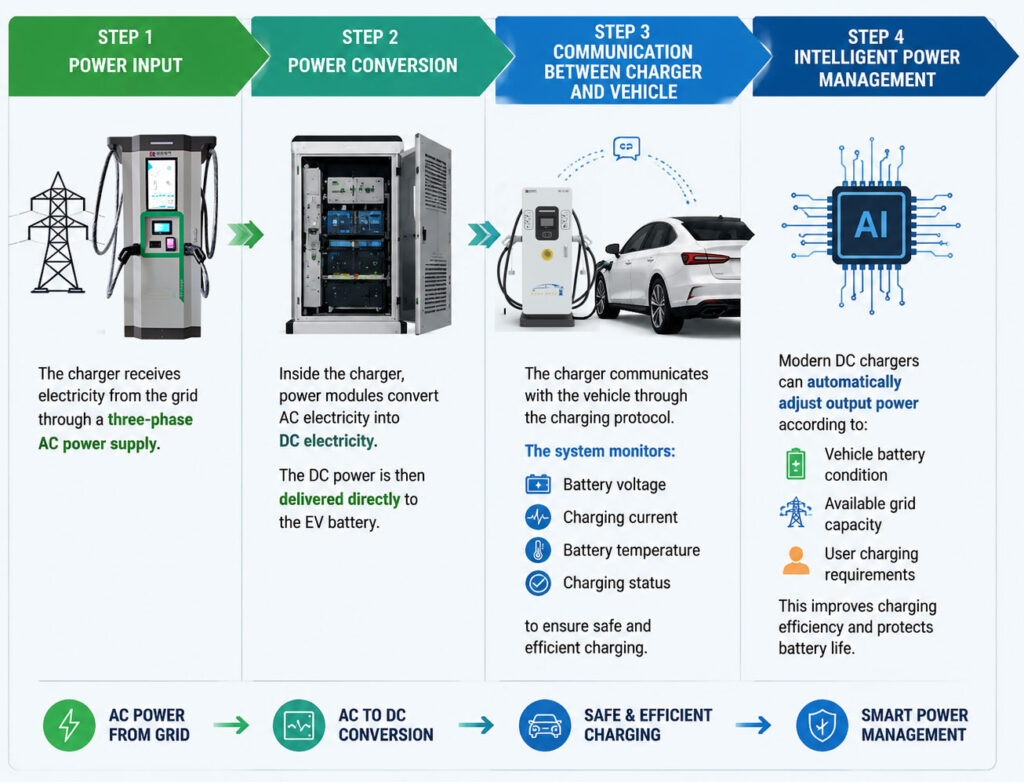
2. How Does a DC EV Charger Work?
Understanding the charging process helps explain why DC chargers are much faster than traditional AC chargers.
3. Why Are Businesses Choosing DC EV Chargers?
The increasing demand for fast charging is driven by several important advantages.
1. Faster Charging Speed
The biggest advantage of DC charging is speed.
Compared with traditional AC charging, DC chargers can significantly reduce charging time.
For example:
- 7kW AC charger → suitable for overnight charging
- 22kW AC charger → suitable for long parking periods
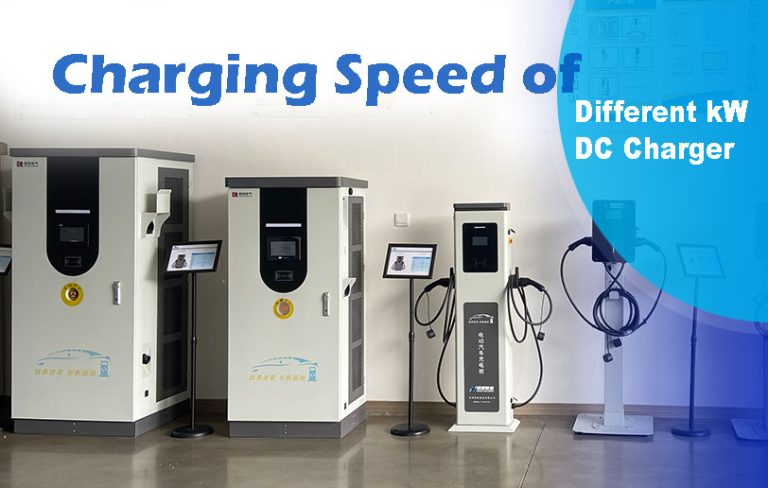
- 60kW-400kW DC charger → suitable for fast commercial charging
For taxi fleets, logistics vehicles, and highway stations, charging time directly affects operating efficiency.
2. Higher Charging Efficiency
DC chargers deliver power directly to the battery, avoiding additional conversion inside the vehicle.
This improves:
- Charging efficiency
- Energy utilization
- Overall charging performance
3. Suitable for Commercial Charging Applications
Residential users may accept slow charging, but commercial operators need faster turnaround.
DC EV chargers are ideal for:
- EV charging stations
- Fleet depots
- Logistics centers
- Bus terminals
- Heavy-duty vehicle charging
because vehicles can return to operation faster.
4. AC Charger vs DC Charger: What Is the Difference?
Many customers are confused about whether they need AC or DC charging.
Here is the main difference:
| Comparison | AC EV Charger | DC EV Charger |
|---|---|---|
| Charging speed | Slow to medium | Fast |
| Power range | Usually 3.5kW-22kW | 30kW-400kW+ |
| Power conversion | Inside vehicle | Inside charger |
| Installation cost | Lower | Higher |
| Application | Home, workplace | Commercial charging |
| Charging time | Longer | Much shorter |
Choose AC charging when:
- Vehicles stay parked for many hours
- Charging speed is not critical
- Residential charging is required
Choose DC fast charging when:
- Vehicles need quick turnaround
- Charging stations serve many users
- Fleet operation efficiency matters
5. How to Choose the Right DC EV Charger?
Selecting the correct charger requires more than choosing the highest power model.
Consider these factors:
1. Charging Power Requirements
Different applications require different power levels.
30kW-60kW DC Charger
Suitable for:
- Small commercial stations
- Workplace charging
- Passenger vehicles
80kW-160kW DC Charger
Suitable for:
- Public charging stations
- Commercial parking
- Fleet charging
180kW-400kW+ DC Charger
Suitable for:
- Highway charging stations
- Heavy-duty vehicles
- Large EV fleets
2. Charging Connector Standards
Different countries and markets may require different charging interfaces.
Common standards include:
- CCS1
- CCS2
- CHAdeMO
- GB/T
A reliable EV charger manufacturer should provide flexible connector options.
3. Smart Charging Functions
Modern EV chargers should support intelligent management features such as:
- Remote monitoring
- Payment systems
- Charging data management
- Load balancing
- OCPP communication
These functions help operators manage large charging networks efficiently.
4. Installation Environment
The operating environment also affects charger selection.
Consider:
- Outdoor or indoor installation
- Temperature range
- Dust and water protection
- Protection level
For outdoor charging stations, reliable protection design is essential.
6. Where Are DC EV Chargers Used?
DC fast charging technology is widely applied in different industries.
Public EV Charging Stations
Shopping centers, parking areas, and urban charging networks use DC chargers to provide fast charging services.
Highway Charging Stations
Long-distance EV travel requires fast charging infrastructure.
High-power DC chargers reduce waiting time and improve user experience.
Electric Fleet Charging
Logistics companies and transportation operators use DC charging solutions for:
- Delivery vehicles
- Electric taxis
- Electric buses
- Commercial fleets
Heavy-Duty Electric Vehicle Charging
Electric trucks require higher charging power due to larger battery capacity.
High-power DC charging systems help improve transportation efficiency.
7. Why Choose Henan Risen as Your DC EV Charger Manufacturer?
Henan Risen specializes in providing reliable EV charging solutions for global markets.
With professional manufacturing capabilities and engineering experience, Risen focuses on developing:
- DC fast EV chargers
- Commercial charging stations
- High-power charging solutions
- Customized charging systems
Our DC EV chargers are designed with:
High Efficiency Power Modules
Providing stable and efficient charging performance.
Intelligent Charging Management
Supporting smart operation and remote monitoring.
Flexible Power Options
Available solutions from medium-power chargers to high-power fast charging systems.
Reliable Safety Protection
Including:
- Over-voltage protection
- Over-current protection
- Temperature monitoring
- Short-circuit protection
Henan Risen helps customers build reliable EV charging infrastructure for the future.
8. Frequently Asked Questions About DC EV Chargers
Q1: How long does a DC EV charger take to charge an electric vehicle?
Charging time depends on:
- Charger power
- Vehicle battery capacity
- Battery charging capability
Higher-power chargers can significantly reduce charging time.
Q2: Is a DC charger better than an AC charger?
Not always.
AC chargers are suitable for long parking periods, while DC chargers are better for fast charging applications.
Q3: What power DC charger do I need?
It depends on your application:
- Private use → lower power charging
- Commercial stations → medium/high power DC charging
- Fleet and heavy-duty vehicles → high-power charging solutions
Q4: Can DC EV chargers support multiple vehicles?
Yes. Some charging systems support multiple charging outputs and intelligent power distribution.
Q5: What should I consider when choosing an EV charger manufacturer?
Look for:
- Product certifications
- Manufacturing capability
- Technical support
- Customization ability
- After-sales service
As a professional EV charging solution provider, Henan Risen is committed to delivering reliable, intelligent, and efficient DC charging solutions for customers worldwide.